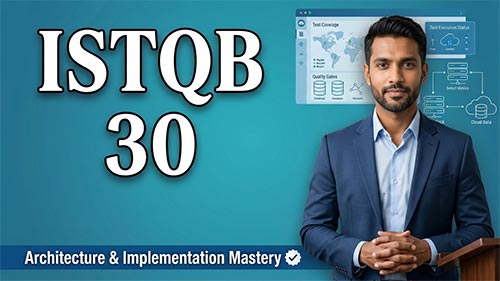
Course name: ISTQB 30
total enrolled 20 classes
per class 2-hour duration
Class type – online live class
About This Course
The ISTQB Certified Tester Foundation Level (CTFL) course is designed to provide a strong
foundation in software testing principles, methodologies, and best practices. Whether you are a
beginner looking to start a career in Quality Assurance (QA), a manual tester seeking
professional certification, or an IT professional wanting to enhance your testing knowledge, this
course will help you achieve your goals.
The course covers all key concepts defined in the latest ISTQB Foundation Level syllabus,
including testing fundamentals, software development life cycles, static testing, test design
techniques, test management, and testing tools. Each topic is explained in a simple and practical
manner, making it easy for learners to understand and apply the concepts in real-world projects.
This is a comprehensive training program that combines theoretical knowledge with practical
examples, exam-oriented discussions, and practice questions. Students will learn how to design
effective test cases, identify defects, understand different testing techniques, and contribute to
software quality throughout the development lifecycle.
The course is suitable for Manual Testers, Automation Testers, QA Engineers, Business
Analysts, Developers, Scrum Team Members, and fresh graduates interested in software testing.
No prior ISTQB knowledge is required.
By the end of this course, participants will have a clear understanding of software testing
concepts and will be well-prepared to pass the ISTQB CTFL certification exam. In addition, the
knowledge gained from this course will help learners perform more effectively in real-world QA
and software testing roles.
What you will get in this course
Fundamentals of Testing (20%)
Why testing is necessary
Testing objectives
Testing principles
Test activities and tasks
Testware
Traceability between test basis and testware
Testing Throughout the Software Development Lifecycle (10%)
Testing in different SDLC models
Test levels
o Component Testing
o Integration Testing
o System Testing
o Acceptance Testing
Test types
o Functional Testing
o Non-functional Testing
o White-box Testing
Confirmation Testing and Regression Testing
Static Testing (10%)
Basics of static testing
Feedback and review process
Review types
o Informal Review
o Walkthrough
o Technical Review
o Inspection
Success factors for reviews
Test Analysis and Design (35%)
(Most important chapter for the exam)
Test techniques overview
Black-box techniques
o Equivalence Partitioning
o Boundary Value Analysis
o Decision Table Testing
o State Transition Testing
White-box techniques
o Statement Coverage
o Branch Coverage
Experience-based techniques
o Error Guessing
o Exploratory Testing
o Checklist-based Testing
Collaboration-based testing approaches
Managing the Test Activities (20%)
Test planning
Risk management
Test monitoring and control
Configuration management
Defect management
Metrics and reporting
Test Tools (5%)
Tool support for testing
Benefits and risks of test automation
Tool selection and implementation
Types of testing tools
o Test Management Tools
o Defect Tracking Tools
o Static Analysis Tools
o CI/CD Tools